Can Enlightenment coexist with worldly concerns? Explore the remarkable life of a man whose path blends destiny, mindfulness, and a deep sense of purpose.
Reading time: 30 minutes
A Special Day
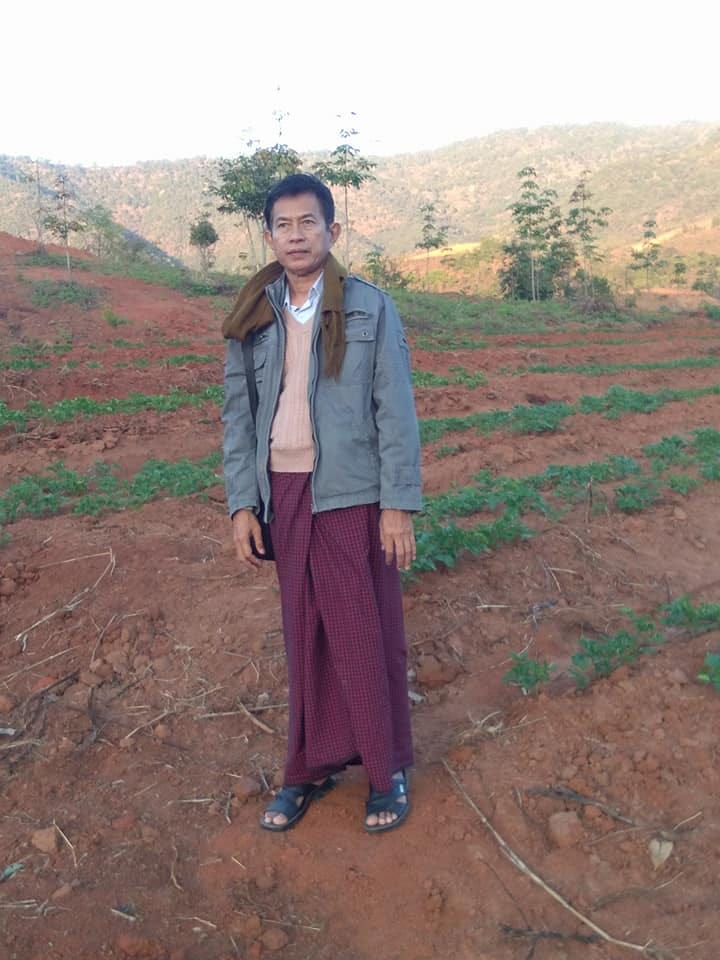
HIS hand was steady, poised. His eyes, distinct and bright, rested thoughtfully on four children seated cross-legged on the floor. Streaks of grey ran through his hair like silver spines, lending the slim man in his mid-thirties an older, more distinguished air.
He carefully chalked round Burmese-script letters in neat vertical lines on a temporary blackboard. Quiet and serene, he dominated the living room of the modest wooden house in a sleepy Yangon suburb. It was one of the sweltering months from March to May, the height of summer holidays, when the children had been invited to this impromptu gathering.
They had known him as a private tutor who taught high school English and biology, but the words he was writing today clearly belonged to another realm.
Of the words written, the children recognized only the first three: lobha (greed), dosa (hatred), and moha (ignorance). These were familiar Pali terms that had long found a place in everyday Burmese.
“Here is a summary of kilesas1, the defiling tendencies that cloud the mind,” the man began. “Each of us—you, me, everyone—is born with these tendencies. Just as fine dust and other impurities make clear water murky, these defilements cloud the mind’s natural clarity, obscuring our ability to see clearly and respond wisely. Like actors waiting in the wings, they step onto the stage of our minds when the right conditions arise, and influence how we behave, speak, or even think, often in unwholesome ways. In doing so, they keep us caught in the cycle of suffering.”
He then went on to explain each of the kilesas in detail using relatable everyday examples, unpacking abstract concepts—which, for adult learners, can delve into philosophical or even metaphysical2 questions—in a way that children could grasp. He paused now and then to make sure they were keeping up.
Next, he elucidated the Four Noble Persons3, each representing a different maturity on the path toward the ending of suffering4, Nibbāna, where the forces that bind us loosen and fall away.
The children followed much of the talk. But for those whose understanding of Buddhism had been shaped more by custom than insight, many threads in the rich tapestry of meaning and logic in the entire Buddhist doctrine5 remained unconnected. Still, they needn’t have worried even if they couldn’t grasp it all in a single lecture, for their teacher was none other than their beloved uncle, who lived in the same city and visited them very often.
What I heard that afternoon some thirty years ago, as a ten-year-old boy among my three older cousins, remains etched in my memory. The talk was unusual because a general Burmese Buddhist would not typically be exposed to that level of teaching at such a young age. Most children are told the Buddha’s life story, the Jataka tales, or the 38 Blessings of Life, not the kind of advanced lesson that would belong in a high-level Buddhist class.
And yet, whatever I heard from him that day was absorbed into my understanding and has stayed with me ever since. While much of my understanding deepened through personal reading over the following years, it was Lay Lay Aung (“Little Uncle Aung”) who remained my foremost teacher of Buddhism and meditation. For that, I am deeply grateful, and that particular talk remains the most special in my life.
A Special Child
I believe anyone close to Lay Lay Aung found him a special person and had their own special moments with him. In fact, his arrival into the world could itself be seen as something special, unique in its own way. If a long-held family lore is true, he may have been someone who fulfilled two lives in one.
Years before his birth, his parents had lost a young daughter to natural causes. His mother, heartbroken, grieved deeply for the loss of the girl she particularly adored. She saw a clairvoyant who revealed that her deceased daughter was now residing as a nat6 in the Padauk tree just outside the family’s front yard, under the protection of the tree’s guardian nat. Moved by this belief, she began praying to the tree’s nat for a reunion with her child.
It seemed the nat was moved by her prayers. One night, she had a dream in which an old man appeared, holding the hands of a boy and a girl—all clothed in white, indicating that they were pure or spiritually elevated beings—asking her which of the two children she wanted. She chose the boy. Soon after that dream, she became pregnant, and ten months later, gave birth to a son.
Whether by coincidence or some deeper cause, the newborn seemed to affirm her faith. Her new son, she felt, resembled her lost daughter not only in appearance but in temperament. Like her daughter, he had a strong will and quick mind. Overjoyed, she was convinced that her deceased daughter had been reincarnated in the family as a son. She named him Maung7 Hla Aung.
Nevertheless, the loss of her daughter eventually led my grandmother to the Vipassana, insight meditation grounded in mindfulness practice8. It was in this period of mourning, before the birth of her son, that she went to a meditation center and found it valuable. Through the practice, she could lighten her grief and glimpse into the principle of impermanence in life.
Convinced that one of the greatest gifts a parent could offer was to introduce their children to the Vipassana, from then on, she sent her other children—one of whom was my mother—to the meditation center in their hometown regularly. That tradition carried on until Lay Lay Aung was old enough to follow in his siblings’ footsteps.
One evening during one of those retreats, the family’s youngest novice was practicing walking meditation between two sitting sessions. He had chosen a quiet walkway near the abbot’s pavilion. From the corridor, the abbot noticed him and offered a casual yet profound reminder: “Don’t just be mindful of your leg movements, young novice,” he said. “Be mindful of the mind that is observing those movements too.9”
Lay Lay Aung recalled that, following the instruction, he instantly grasped the conditionality of nāma-rūpa—how the mental–physical process arises as a single, interconnected phenomenon.10. At the time, he was too young to describe the experience doctrinally, but later, through avid study and practice, he came to understand that this had been his first clear glimpse of insight that a Vipassana practitioner can gain when practice is done properly.11
“The first and foremost thing to do in life is to practice the Vipassana,” he used to tell his loved ones. “Do it first, and do other things later.”
Despite a moment of early insight at a very young age, he was not especially drawn to being committed to the practice or inspired by the monastic path. Instead, much like any other schoolboy, he was immersed in studies, sports, and the lighthearted joys of youth. But it was the case only until an unforeseen event altered his path.
He spent six years in Yangon, pursuing veterinary science for his Bachelor’s. On the eve of graduation, his dearest friend and roommate died suddenly and without warning. That experience not just saddened him but jolted him awake. In the depth of his grief, he saw with newfound clarity just how fragile and fleeting life truly was.
It struck him, with startling lucidity, that death could arrive for anyone, anywhere, without warning. In such a fragile and uncertain world, many are oblivious to how near death can be, chasing fame, wealth, and status instead of making the Dhamma12 their foremost pursuit. This contemplation, combined with the thought of dying without having realized the Dhamma, filled him with a deep sense of urgency. And that became a turning point in his life and a powerful driving force.
From then on, he entirely turned inward, spending most of his time practicing mindfulness and studying books on meditation and insight practice. Every morning, he would sit in silence for three hours at the Shwedagon Pagoda. Even outside formal meditation, he remained mindful of all his actions, speech, and thoughts, giving only minimal time to daily chores.
Two years later, at the age of twenty-four, he said, the Dhamma eye arose, and with it something settled for good. For him, the path was real, suffering would surely end, and the most important task of a human life had been decisively fulfilled. There was no longer any reason to fear where the road would lead.
Lay Lay Aung’s story strikes me as quietly wondrous: if my youngest uncle was truly the rebirth of the girl who had died before him, then the death of his past self subtly laid the ground for a practice that would one day ripen within him. An image came to my mind: a family elder dies, and his family plants a mango tree in his memory. Later, he is reborn in the same family and one day tastes the fruit grown from a past he no longer remembers.
I often heard Lay Lay Aung say that nothing mattered more than bearing the Dhamma in one’s heart: life and death were only meaningful if that inner mission had been fulfilled. And to truly know the Dhamma, there was no other path than the Vipassana, the Buddha’s Middle Way, a path leading to freedom and release.
“The first and foremost thing to do in life is to practice the Vipassana,” he used to tell his loved ones. “Do it first, and do other things later.”
He never revealed explicitly how far he had progressed in his Vipassana practice, following the tradition where practitioners typically keep their experiences private or share them only with their Vipassana teachers. But the family speculated that he had become at least a “Stream-enterer”, one who had become irreversible and crossed beyond doubt (See Footnote 3).
Having secured a ticket on the final journey, how did he then dedicate his life to the ‘other things’ he spoke of?
For the greater part of his life until his passing at the age of sixty-six, he devoted himself to living a life that was at once philosophical and disciplined.
A Man of Versatility or Controversy?
Inspiration from, and deep respect for his life aside, one thing that often unsettled me was the apparent contradiction in Lay Lay Aung’s path. While he walked the way of purity through the Vipassana, he also pursued worldly knowledge often seen as parallel to, or even in conflict with, the Dhamma.
To orthodox Theravadins, ancient Vedic sciences such as palmistry, numerology, Pali prosody, omen reading, and astrology—known collectively as Lokipañña—were distractions from the true path of Dhamma. For them, the aim was not to unravel cosmic secrets, but to attend to the here and now, shaping one’s actions in the present moment.
Lay Lay Aung, however, held a more inquisitive view. While deeply grounded in the Dhamma, he saw these sciences not as temptations away from the Path but as windows into patterns that might reveal the interconnectedness of life. He never confused them with the ending of suffering; he approached them instead as secondary tools, to be handled with skill and discernment.
Lay Lay Aung acknowledged that these disciplines came from Brahmanism and Hindu traditions, but he rejected the view that they were mere superstitions of primitive cultures. That the Buddha did not endorse such sciences, he argued, did not mean they were false or unwholesome; but only that they were unrelated to ending suffering.
Of all the disciplines he studied, astrology was the one my uncle held in highest regard. He said he was drawn to it after noticing that certain predictions had, uncannily, come true. Intrigued by its veiled logic and the mystery of unseen causes, he sought to read the cosmic book for himself. He approached several humble masters—men he believed truly understood the science but passed down their knowledge only in whispers, and only to those deemed worthy.
Yet he rejected the prevailing misconception that astrology could serve as a kind of rescue or protection. For him, destiny was not something to be bargained with. Astrology did not intervene in fate13; it revealed it.
To believe in astrology meant to believe in destiny. The idea carries a haunting certainty: something not unlike the scenes in Final Destination, where fate unfolds with relentless precision. A person destined to die will die: no escape, no detour. But unlike in those films, my uncle found peace and clarity in the knowledge. He believed that understanding one’s course of life allowed for wiser choices. After all, don’t we still have freedom, even if we know our fate in advance: whether to meet it in distress or to prepare our minds and spend the moments with purpose in the face of impending woe(s) or even death?
While admitting that not all astrologers’ predictions came true, he never doubted the science’s underlying validity. He firmly believed that astrology could yield precise results though the accuracy, he said, depended both on the astrologer’s skill and samadhi (the depth of mental unification developed through sustained training).
“You possess an enlightened heart.”
Decades ago, I asked my uncle whether the script of one’s life could ever be rewritten.
“In most cases, no,” he said. “A person’s life unfolds along a path already laid down. Yet with immense samadhi, it may be possible to bend that path slightly, though not to alter it outright. Such cases, however, are rare.”
I found the idea deeply troubling at first, especially since the Buddha rejected the fatalistic view that all events arise solely from past kamma14 as mistaken. For a long time, I wrestled with the tension between destiny and free choice. Do we succeed because our lives were always meant to unfold that way, or because we persevered? Does one realize the Dhamma in this lifetime because it was destined, or because one chose to walk the Path?
Lay Lay Aung reconciled these two ideas. He held that past kamma shapes the framework of this life. It sets the broad contours of our existence: our parents, birthplace, gender, temperament, social position, and even the timing of major events such as marriage, support, fame, decline, or death. Yet while this larger architecture may be conditioned, the present moment remains open. Within it lies our freedom: to respond, to choose, and to shape the finer details of each phase of life. It is here that volition does its work.
My uncle’s reference to “immense samadhi”, as I understand, pointed to the inner discipline required to act with clarity and restraint in steering our thoughts, speech, and deeds away from unwholesome impulses, or the influence of our kilesas. In this view, freedom is not the absence of conditioning but skillful engagement with it.
Lay Lay Aung not only studied those sciences but also consulted, out of curiosity, at least two of Myanmar’s most renowned fortune tellers: Swe Swe Win (better known as ET) and San Zarni Bo. ET, who passed away in 2017, was said to have advised several powerful figures, including former junta leader Senior General Than Shwe and ex–Thai Prime Minister Thaksin Shinawatra.
Whatever ET told my uncle is now lost to time. But what I heard from my uncle’s recording on a C60 tape remains etched in my memory: San Zarni Bo said after reading his palms, “Brother, you possess an enlightened heart.15”
Special, but Single
Single, But Special
Lay Lay Aung was never seriously obsessed with in romance or marriage, a tendency he often attributed to his inborn nature, as reflected in the planetary alignments in his birth chart. Regardless, he had always been a peculiar figure, even from an early age. His former female classmates remembered him as a boy too conceited to befriend or flirt with girls. “Your uncle had a very serious face back then,” one of them recalled, smiling. “He barely talked to us.”
He may have been a cherished son, a devoted brother and uncle, a trusted friend, and a respected teacher, but he was hardly the kind of man to chase after a woman or plead for her love. Some were drawn to him, but he was not one to pursue romance unless he sensed that the feeling was mutual. He seemed to prefer two people arriving at an understanding together, each taking a step towards the other. He remarked more than once that he had never said “I love you” to a woman or proposed to one.
That didn’t necessarily mean he had never loved. Rather, his understanding of love between a man and a woman, and ultimately their union, was rooted more in mutual care, understanding, and companionship than in mere infatuation or fleeting desire. To him, a life partner was a gift to be received, not a prize to be won. Just as he saw friendship as something that grew from chance encounters rather than deliberate searching, he believed that a soulmate, too, could only be met—not chased. There was a time when it seemed he was genuinely considering marriage, but unforeseen events quietly brought that chapter to a close.
Ironically, though he had never pursued a romantic relationship himself, Lay Lay Aung was one of the most trusted advisors on matters of love, courtship, and marriage among his friends and even his students. What often made us smile was how this lifelong bachelor was often invited to serve as master of ceremonies at the weddings and engagements of those close to him. There was something endearing about seeing someone so steadfastly single and seemingly untouched by romantic entanglements speaking so earnestly about love, marriage, and partnership.
The last time he was invited, he never made it. The bride was one of his former pupils, and he had even bought new clothes for the occasion. But just days before the wedding, he passed away. He never wore those new clothes; the outfit became his funeral attire instead.
A Near Ascetic, Thoughtful Cook, and Mindful Healer
Lay Lay Aung never lived a life of comfort or indulgence. He didn’t even sleep in a proper bed. Just a Burmese deckchair was enough. Mosquitoes bit him through the night, but he neither bought a mosquito net nor swatted them away, nor did he approve when others did.
For much of his youth and midlife, he lived in a humble private hostel room and often relied on his own feet and Yangon’s inefficient public transport system as he made home visits as a private tutor. Many times, he simply chose to walk long distances instead.
My grandmother, observing his modest lifestyle, often felt saddened. Though a qualified veterinarian who could have earned a more substantial income, he had consciously chosen a different path he deemed blameless.16 With a mix of sarcasm and sorrow, my grandmother—who, like many Burmese parents of her time, regarded the medical profession as the highest and most dignified career path—once quipped that the sheer amount of walking he did for a living was enough for his thighs to spark.
Lay Lay Aung slept very little each day, often spending much of the night sitting still in his deckchair, practicing mindful breathing. He didn’t believe in the popular notion that eight hours of sleep were necessary for good health. In fact, he claimed that despite his minimal rest, he was healthier than most people who spent longer hours in bed. And indeed, we rarely heard him complain of illness.
“Buddhas and arahants sleep only briefly each day,” he once explained. “Perfected Ones17 have very deep samadhi as a result of being free from all kilesas, and their bodies remain naturally energized. In contrast, ordinary people, burdened by kilesas, grow weary by day’s end. The calmer the kilesas, the less rest is required.”
As a teenager, Lay Lay Aung had a strong, muscular build thanks to his interest in bodybuilding and martial arts. But in his later years, he became lean, shaped by a strict diet and his disciplined approach to meditation. He never ate beyond his limit, no matter how much he enjoyed a dish.
Ironically, he loved cooking. Whenever there was a special occasion, he took charge of the kitchen. Both his parents were excellent cooks, and he blended their styles with his own flair. Anyone lucky enough to taste his food would quickly give him five stars. He also taught himself to be a tea master in a short time and volunteered as one briefly at a friend’s teashop in downtown Yangon when I was a child. I still remember how proud he looked when he invited us to his roadside stall and served us himself.
Despite his modern medical training, he held deep knowledge of and strong faith in Myanmar’s traditional medicine system, Taing-yin-say. This system, dominant before Western medicine arrived, combines ancient Hindu Ayurvedic influences with local practices and extensive herbal remedies.
I recall one example that stood out. A post of unknown origin once went viral among local Facebook users, warning about the toxicity of djenkol, a tree whose seeds are often eaten with fish paste sauce (ngapi-yay). My uncle disagreed. He believed that eating djenkol was generally safe because it was traditionally consumed alongside ngapi-yay and a variety of vegetables. According to his understanding of Taing-yin-say, the toxic acids said to be present in the beans could be neutralized by the raw or boiled vegetables served with them.
He explained this in detail, drawing on his knowledge, but I let his words slip past me and the finer points faded soon. My attention too transient.
To him, the habits of earlier Burmese generations were never arbitrary. Everything had a reason. Take htamanei, for instance. The glutinous rice delicacy, eaten during the lunar month of Tabodwe (January or February), isn’t just a seasonal treat. He believed its ingredients were meant to strengthen the body in preparation for the approaching hot season, from March to May.
The Scholar-Activist
As I know, Lay Lay Aung had two enduring ambitions in life: to become a Buddhist scholar and write a book on Buddhism in English, and to contribute meaningfully to the organic movement in Myanmar and beyond.
To pursue the first, he enrolled at the International Theravada Buddhist Missionary University in Yangon in his late forties, hoping to study the Dhamma18 in a more structured and scholarly way. Though recognized as an outstanding student, he eventually clashed with some professors and the university’s leadership due to his outspoken criticism of their teaching methods and curriculum. Despite graduating with a Bachelor’s degree and earning distinctions, he chose not to continue on to a Master’s.
His aspiration to support the organic movement took root in his late fifties and remained a focus until the end of his life. Deeply concerned about genetically engineered crops, increased pesticide use, and chemical-intensive farming practices, he traveled across the country as well as to regional neighbors, and took part in activities advocating for natural and sustainable practices.
A Wild Card
Unlike some who claim to be religious yet prefer solitude or disentanglement, Lay Lay Aung never turned away from the messes around him. He believed that embodying the Dhamma meant standing with people in both their joys and their sorrows. He was a patient listener and welcomed anyone who came to his doorstep seeking help or guidance.
He never forgot a kindness. Whether from family or strangers, he remembered every favor, repaid it when he could, and forgave offenses without hesitation. The only kind of help he rarely offered was financial. He simply didn’t have the means. But when someone close to him fell ill, he was always the family doctor, if the case was manageable, and the caregiver. Short of money, yes, but never short of presence, effort, or care. In that sense, my uncle was a wild card, someone people could always count on, no matter the situation.
“Try not to become a man of success. Try to become a man of value.”
There were strong winds, heavy rains, and thunderbolts in Lay Lay Aung’s life too. He was slandered and wrongly accused. He faced lawsuits, filed against him for doing what he believed was right. At worst, he was cheated out of large sums of money after guaranteeing a loan that went unpaid. Looking back, the series of blows he endured were devastating. And yet, he remained stoical, weathering them all with quiet resilience and unwavering will. I never once saw him seeming dispirited or heard him blame anyone. He believed it was simply his destiny; and one must accept both good and bad fortune with equanimity.
He urged those close to him to practice the Vipassana as much as possible. The course of our life may have been laid out, he said, but the present moment is ours. We cannot undo our past kamma, and we may not escape our destined course, but we have the freedom to choose to live each moment mindfully and wisely.
He once said that his birth chart bore no signs of sustained wealth or comfort, despite the profound respect he earned as a teacher and spiritual guide. That, in hindsight, proved strikingly true. He worked diligently in all his callings, but fortune never truly followed him. His path, it seemed, was to have money flow in often but never stay for long, leaving him always in a state of uncertainty.
That said, a motto upheld by an old friend of mine came to mind: “Try not to become a man of success. Try to become a man of value.” My uncle could certainly fit into that category.
A Distant Dawn
My uncle maintained a notebook that served as his personal astrological archive, filled with natal charts of friends and family that he had meticulously drawn by hand. Anyone close could rely on him as a lifelong advisor. Of all the charts he studied, he knew the country’s by heart, having returned to it so often over the years. He needed neither his notebook nor an ephemeris (an astrological calendar used to track planetary movements) at hand: he could readily recall the positions of its natal planets, tell which planets were transiting which houses at any given moment, and speak of what their movements might portend.
He believed Myanmar’s birth chart—cast for the exact moment of its independence (January 4, 1948, at 4:20 AM)—reflected an astrological alignment favoring military dominance. That, he said, explained the root of the nation’s continuing misfortunes.
Lay Lay Aung did not share popular euphoria particularly when the National League for Democracy won the 2015 elections in a landslide. At the time, he predicted that the country’s misfortunes were far from over; Myanmar would continue to face serious challenges until 2020, only to face an even worse fate afterward. He even predicted, correctly, that the NLD’s elected president, U Htin Kyaw, would not complete his term19 20.
Between 2020 and 2025, he said, the country would be like an old house being demolished to make way for a completely new one. According to him, real change would not begin until after 2025, when Myanmar would slowly begin to leave its long-standing woes behind and, by 2030, the outlines of its future would come into clearer view. From 2030 onward, he believed, the nation would shine in a way that would draw admiration from its neighbors. In his reading of the heavens, nothing in the planetary configurations since independence had promised the country a future as auspicious as the one that lay beyond 2030.
As I reflect on his words, I can’t help recalling a famous passage from Romance of the Three Kingdoms, in which the scholar Cui Zhouping explains to Liu Bei—the scion of the Han royal family, who is deeply disheartened by chaos and the dynasty’s decline—that history moves in cycles, with periods of peace and prosperity eventually giving way to disorder, and disorder in turn yielding to peace. The Han itself had risen from chaos, enjoyed two centuries of stability, fallen into turmoil, and then been restored. What Liu Bei was witnessing, Cui suggested, was simply another turn of that wheel.
And yet, as I reflect on my uncle’s prediction of a more favorable future for Myanmar, I can’t help seeing a Buddhist idea beneath this seemingly cyclical view of history: impermanence.
As we contemplate our nāma-rūpa, do we not become aware that both physical and mental phenomena are constantly arising and passing away? Countries, civilizations, order, disorder, the earth, and even the universe itself, too, come into being and pass away. It is only the scale of time that differs. Our lifespans are sometimes too short to witness a country’s fortunes turning: to see its decline give way to renewal, or its prosperity eventually give way to decline.
If we could somehow outlast the universe, I reckon that every historical event that has ever unfolded on Earth—civilizations rising and falling, eras of peace and chaos—would appear no different from the fleeting moments of our own sensations, feelings, and thoughts, the very phenomena we learn to observe during mindfulness practice.
A Departing Light
Lay Lay Aung believed that astrology could predict a person’s final moment. Whether he ever glimpsed his own, I’ll never know. His death came suddenly, without warning, uncannily mirroring the passing of his closest friend from university.
“I’m okay. I’ll be fine. It’s just a minor ailment,” he told us, his voice light, his smile unchanged as if gently shielding us from what he knew lay ahead. No one suspected his death was imminent. Though he looked obviously very weak, his cheerful demeanor and readiness that day to engage in casual conversation with me about Myanmar’s post-coup crisis and Russia’s aggression against Ukraine gave me no hint of what was coming. And then, in calm and dignity, he gasped for breath and slipped away, just as a candle goes out not with a flicker, but with stillness.
The suddenness of his death, too, sent a shockwave and a sense of spiritual urgency (samvega) deep within me. It brought to mind Lay Lay Aung’s own life-turning experience and the quiet fear that had once awakened him. I, too, was shaken; and jolted awake as well. But alas, after a month of earnest meditation, I gradually drifted back into the pull of daily distractions and the lure of sensual pleasures.
His passing also rekindled an old question in my mind: Is there such a thing as fate? Will something destined to happen surely happen at the exact moment? Can nothing truly prevent it? I still believe his life could have been saved under different circumstances.
But it was during the peak of COVID-19. The emergency ward at Yangon’s main public hospital was temporarily closed, as most of its staff were infected. Private hospitals were hesitant to admit a suspected COVID patient, demanding additional screenings before offering treatment. The delay meant he couldn’t get oxygen in time. Was it ‘fate’, meticulously arranging everything, that led to a death that could otherwise have been avoided?
Beyond grappling with fate and free will, a deeper question often stirred within me: Was there a hidden purpose behind my youngest uncle’s final return? Could his life—from birth to his friend’s tragic death—have been subtly guided by an unseen design, gently steering him toward the Dhamma in this very lifetime?
Lay Lay Aung once said, without hesitation, that he was unflinchingly ready for it anytime because the Dhamma was in his heart. Watching the calm and quiet dignity with which he met his final moments, I couldn’t help but believe he may have been right. Just as a student who has thoroughly mastered the entire curriculum has no fear of an exam, one who has fulfilled the Dhamma has no fear of death.
I’ve heard it said that every dying person instinctively knows when their time has come. My uncle may or may not have sensed it, but I can only imagine that, as someone who practiced mindfulness all his life, he would have met his final moment with full awareness, attuned to the unfolding nāma-rūpa as the countdown neared its end. Who knows if, in those last seconds, he touched a higher level of Awakening?
Watching him die, I realized how thin the boundary is between life and death. Life is like an earthen pot—or a thread, as the Western tradition puts it—fragile and fleeting. Once it breaks, it cannot be mended.
When someone is gone, they remain only in the memories of those who knew them. And in that space, the living reflect on the legacy the departed leave behind, good or bad. My uncle’s image, as a singular and special person, will linger in the minds of those who loved him for many years.
But as time passes, even those memories will fade, and one day, vanish with us too.
Kilesas, in a summarized version, are:
Lobha (Greed): craving for sensual pleasures, material possessions, or other forms of gratification
Dosa (Hatred): aversion, anger, or ill-will toward others or oneself
Moha (Delusion): ignorance of the way things really are, leading to misperceptions and poor judgment
Māna (Conceit): pride, an inflated sense of self, or comparing oneself to others
Diṭṭhi (Wrong View): holding mistaken beliefs about the nature of reality, often leading to attachment and suffering
Vicikicchā (Doubt): uncertainty or indecision, particularly regarding the Buddha’s teachings
Thīna (Sloth): mental dullness or sluggishness, a lack of energy for spiritual practice
Uddhacca (Restlessness): mental agitation, distraction, or difficulty settling the mind
Ahirika (Shamelessness): lack of moral shame or concern about unwholesome actions
Anottappa (Recklessness): lack of caution or concern about the consequences of unwholesome actions.
Buddhist texts note that a more complete list enumerates up to 1,500 kilesas.
People from any cultural background can recognize kilesas as part of ordinary experience as tendencies like greed, anger, or confusion naturally arise in the mind. At this level, their existence is uncontroversial and practical rather than metaphysical. But when we ask questions such as, “Does greed always lead to suffering?”, “Greed can drive progress and ambition—can it sometimes be beneficial?”, or “Aren’t emotions like anger part of being human?”, we enter a more reflective or philosophical domain. These are the kinds of questions adults may wrestle with when engaging more deeply with the Dhamma.
The Four Noble Persons are, in order: Stream-enterer (Sotāpanna), Once-returner (Sakadāgāmi), Non-returner (Anāgāmi), and Perfected One (Arahant).
A Stream-enterer has gained irreversible insight into the Dhamma, abandoning key forms of attachment and doubt, and will no longer fall into the lower realms. Their path now flows steadily toward the end of suffering.
A Once-returner continues to weaken remaining defilements and will be reborn in the human or heavenly realm at most once more before fully attaining liberation.
A Non-returner has abandoned sensual desire and ill will, and will not return to the human or lower realms, progressing toward full liberation in a higher plane.
A Perfected One has completely abandoned all defilements and brought the cycle of repeated rebirth to an end, realizing the complete cessation of suffering (Nibbāna).
Though rooted in the Sanskrit term Nirvāṇa, the Buddhist Nibbāna has a more precise meaning. It refers to the complete cessation of suffering, realized through insight and understanding developed in practice. See Footnote 3 for the Four Noble Persons, who progressively abandon defilements along the path to liberation.
These ideas are explored in the Abhidhamma, one of the three sections of the Tipitaka (“Three Baskets”), as the Buddhist Canon is known. In Theravada tradition, the Abhidhamma is often regarded as more systematic than the Suttas (Discourses) section, and is traditionally believed to have been taught in full by the Buddha. Modern scholars, however, see it as a later work, an organized interpretation and elaboration of the Suttas, developed over centuries by Buddhist thinkers.
While “spirits” is a common translation for nats, it’s not entirely accurate. Nats are often viewed not as formless, ever-lasting entities, but as sentient beings who belong to a different realm in the Buddhist cosmology. They are a diverse group: some received unfortunate rebirths and have an uncertain existence due to negative mental states at the moment of death, while others were reborn as a kind of deity, and—inhabiting the natural world—share the Earth’s fortunes with the living. Fore more on nats: https://substack.com/home/post/p-169203135
‘Maung’ is a Burmese honorific used for boys and younger men, roughly equivalent to ‘Master’ in older English usage. For older or adult men, the corresponding honorifics are ‘Ko’ and ‘U’. In Burmese culture, addressing someone with the appropriate honorific is considered both respectful and essential in formal and everyday communication.
The Vipassana involves maintaining mindful attention on significant physical and mental phenomena, such as sights, sounds, sensations, and emotions. At first, the mind often wanders, and the practitioner struggles to remain present. With practice, immersion (samadhi) develops, and the observing mind begins to notice how all phenomena arise and pass away, revealing their impermanent, unsatisfactory, and selfless nature. Through this direct understanding, the practitioner moves closer to the cessation of suffering, progressing along the path toward Nibbāna.
“ရွေ့နေတဲ့ခြေထောက်ကိုချည်းပဲ မရှုနဲ့။ အဲဒီရွေ့နေတဲ့ ခြေထောက်ကို ရှုနေတဲ့စိတ်ကိုပါ ပြန်ရှု။”
Nāma-rūpa is often rendered as “mind and body,” but in early Buddhist teaching it refers to lived experience as a single, interconnected process. Nāma describes mental aspects such as feeling, perception, and intention, while rūpa refers to physical form and sensation. Insight into nāma-rūpa does not separate mind from body, but reveals how experience unfolds through their mutual conditioning, moment by moment.
In Theravada Abhidhamma and later commentarial literature, insight practice is presented as a numbered and systematized sequence of insight knowledges (ñāṇas) leading up to stream-entry, commonly described as sixteen (or, in some traditions, ten) progressive glimpses of insight. Modern scholars generally understand this scheme as a later interpretive framework that organizes meditative experiences suggested in the Suttas, rather than a fixed or universally prescribed path taught in the early teaching themselves.
In Buddhism, the term “Dhamma” has multiple meanings: the teachings of the Buddha, core principles and practices taught by the Buddha to end suffering; Fundamental Laws of Nature, such as impermanence, suffering, and non-self; Phenomenon, all mental and physical events, including thoughts, emotions, and physical objects; Righteousness, Morality, or the Path of Ethical Conduct; and Justice or a set of rules governing behavior. The specific meaning of Dhamma depends on the context in which it is used. In this context, it means the realization of the Path.
Note that while ‘fate’ and ‘destiny’ appear frequently throughout this article, I do not use them in the sense a general English reader understands. These terms are employed to avoid jarring the reader with a barrage of Buddhist terms.
Kamma in Buddhism refers to intentional actions of body, speech, and mind. Within the cycle of rebirth (saṃsāra), wholesome and unwholesome actions can bear results that influence the circumstances of future lives. Kamma is not a fixed destiny, however, but one of several conditions shaping the course of existence across different realms of rebirth, including heavenly, human, animal, and states of intense suffering.
“ခင်ဗျားနှလုံးသားမှာ တရားထူးကိန်းတယ်။”
Though briefly serving as an officer overseeing animal husbandry under the then socialist government, believing meat production to violate the first moral precept (not to kill any living being), he conscientiously abandoned this career path.
Perfected Ones here refers to both Buddhas and arahants. In English, Buddha is commonly rendered as “the Awakened” or “the Enlightened One,” while arahant is often translated as “the Perfected One.” Both fully realize Nibbāna and are equal in liberation; they differ only in the manner of awakening. A Buddha discovers the path independently and teaches it to the world, while an arahant realizes the same liberation through the teaching of a Buddha.
The contextual meaning of ‘Dhamma’ here is “the teachings of the Buddha”.
U Htin Kyaw served as the President of Myanmar from 30 March 2016 to 21 March 2018. He resigned from office, officially citing health reasons. He was succeeded by U Win Myint, then Speaker of the Lower House.
U Htin Kyaw’s supposed birth chart went viral online after his election as President.
Comments
Post a Comment